December 31, 2015

Nilometers of Ancient Egypt

Nilometers, as the name literally suggests, were used to measure the level of the river Nile in Egypt. Nilometers  were  large structures built by ancient Egyptians along the Nile river to measure impending water rise during annual floods. The Nilometers were calibrated with markings in cubits (1 cubit is approximately 50 cms) to interpret the water level.
 
16 cubits meant the right amount for an abundant harvest, while too low or too high levels meant devastation due to famine and over flooding respectively.

 
Nilometer
The conical ceiling of the Nilometer at Rhoda Island near Cairo, Egypt
You can find a wonderful picture gallery of these amazing structures at Amusing Planet.

December 30, 2015

Water in Art: Claude Monet's Moulin A Zandaam

Moulin A Zandaam or Windmill of Zandaam
Claude Monet [Public domain, US-PD], via Wikimedia Commons
19th century French landscape painter Claude Monet is renowned worldwide as one of the founders of the French Impressionist painting movement.

His iconic waterscapes such as "Water Lilies" are among some of the best known and reproduced paintings in the world. This post features one of the 25 paintings that he made while staying at Zandaam in the Netherlands in the 1870s.

December 29, 2015

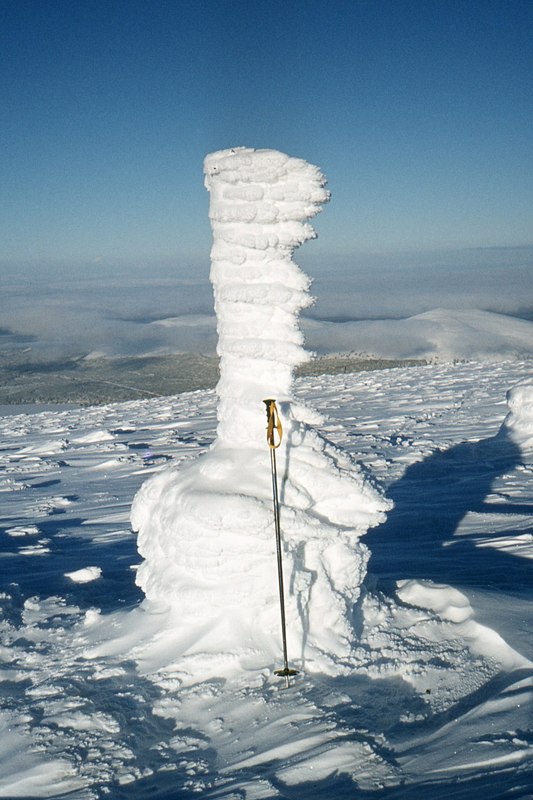
Water's Super States: Supercooling


Liquid water turns into solid ice at its freezing point of zero degrees C.
 
Under special conditions, water retains its liquid state even below freezing point. This state is known as supercooled water. Supercooling occurs when the temperature of a liquid drops below freezing point in the absence of seed nuclei required to create the crystal structure for a solid shape.
 
Supercooling is not a laboratory process, but occurs naturally in one of the most commonly observable phenomenon - clouds. The reaction of supercooled clouds with solid surfaces or heat from jet engines creates results in some stunning formations in nature.


Rimed post near Cairn Gorm summit in Scotland.  Compare with the picture below taken in summer.
Rime builds up in clouds when supercooled droplets (liquid water below freezing) carried by the wind impact on any obstacle and immediately freeze.
Photo By: Jim Barton [CC BY-SA 2.0 ], via Wikimedia Commons


Cairn Gorm summit in summer
Michael Graham [CC BY-SA 2.0], via Wikimedia Commons


December 28, 2015

Coral Reefs

Coral reefs are rocky formations created in marine areas by living organisms such as polyps and algae through the secretion and deposition of limestone over stony corals.

Coral reefs are built and grow over centuries into large and diverse coral reef ecosystems creating a complex habitat of aquatic plants, corals, fish and other marine species. They are sometimes referred to as "rainforests" of the sea.

Coral reefs can be found all over the world, although a majority of them exist in tropical zones.

Corals fringing the coast are a common sight but barrier reefs are largest and most impressive are of them. Barrier reefs are like large, continuous mountain ranges, separated from land by lagoons.

Australia's 2,000 km long Great Barrier Reef is visible from outer space
Image courtesy NASA/GSFC/LaRC/JPL, MISR Team
 

December 27, 2015

Water in Wild - 3

Blue Whale - NOAA Photo
Humpback whale - Megaptera novaeangliae - breaching. NOAA's Ark - Animals Collection
Image: NOAA

December 26, 2015

Deepest Spot on Earth: Challenger Deep in The Mariana Trench

Mount Everest in the Himalayas is the highest mountain peak on Earth, standing tall at 29,000 feet or approximately 5.5 miles from sea level. The Earth's oceans at some points are deeper than the highest mountain peaks. Deep under the oceans run mountain ranges, peaks, valleys and trenches as awesome in scale and variety as those above land.

The deepest known underwater point is Challenger Deep, in the 1500 mile long Mariana Trench which is one of the known deepest and longest underground trenches. Challenger Deep is 7 miles below sea level and can easily submerge Mount Everest.  At this depth, the water pressure is intense and temperatures at sub-zero, beyond the reach of sunlight.


Deep Challenger in Mariana Trench
Kmusser [GFDL , CC-BY-SA-3.0  or CC BY 2.5 ], via Wikimedia Commons
While marine life is found even at these unfathomable depths, it is very difficult for humans to descend there. Till date only two manned expeditions have been made to Challenger Deep.

Data + Design - May - Challenger Deep
From Visually
 
The first expedition was made in 1960 and second and most recent expedition, Deep Sea Challenge, was made by Hollywood film maker and undersea explorer James Cameron in collaboration with the National Geographic in 2012.
 

December 25, 2015

Seasons's Greetings Feature: Christmas Island

 
Imagine a beautiful island as a Christmas gift from Santa Claus! Christmas Island, an Australian territory in the Indian Ocean, is called so because it was first discovered by an English ship that sailed past it on Christmas day in the seventeenth century.
 
With numerous endemic species thriving in its forests and surrounding ocean, the island is often referred to as the Galapagos of the Indian Ocean. With a tropical climate, and December temperatures in the eighties (F), Christmas Island sounds like an ideal destination for a winter vacation as well.