Showing posts with label Physics. Show all posts

December 29, 2015

Water's Super States: Supercooling


Liquid water turns into solid ice at its freezing point of zero degrees C.
 
Under special conditions, water retains its liquid state even below freezing point. This state is known as supercooled water. Supercooling occurs when the temperature of a liquid drops below freezing point in the absence of seed nuclei required to create the crystal structure for a solid shape.
 
Supercooling is not a laboratory process, but occurs naturally in one of the most commonly observable phenomenon - clouds. The reaction of supercooled clouds with solid surfaces or heat from jet engines creates results in some stunning formations in nature.
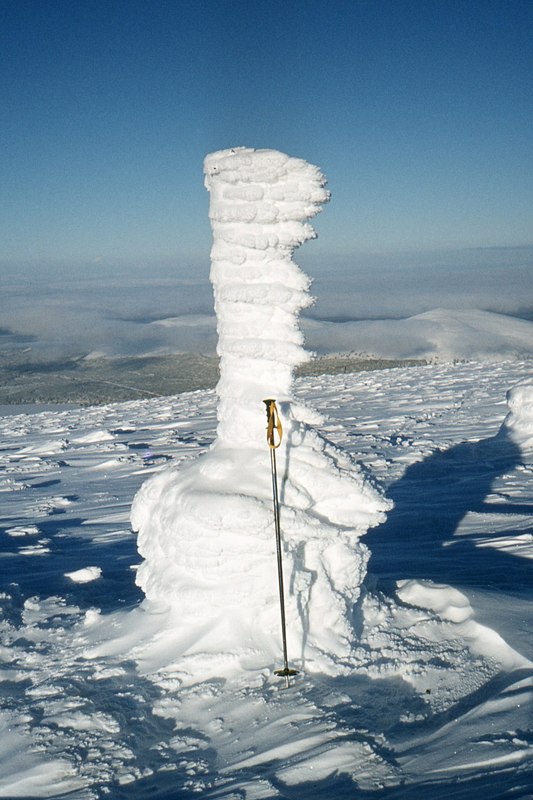

Rimed post near Cairn Gorm summit in Scotland.  Compare with the picture below taken in summer.
Rime builds up in clouds when supercooled droplets (liquid water below freezing) carried by the wind impact on any obstacle and immediately freeze.
Photo By: Jim Barton [CC BY-SA 2.0 ], via Wikimedia Commons


Cairn Gorm summit in summer
Michael Graham [CC BY-SA 2.0], via Wikimedia Commons


December 22, 2015

Unique Properties of Water

Water has many unique properties that make it force that sustains life in this world.

A nice scientific explanation of its dozens of unique properties  can be found at Dr. Michael Pidwirny & Scott Jones University of British Columbia's physical geography website and UC Davis ChemWiki. YouTube is full of student and serious research photos as well.

For a quick demonstration, these everyday videos highlight two of the commonly known properties of water.

Water is a Universal Solvent
Water can dissolve the most substances i.e. solids and liquids.


Water has Surface Tension
Water molecules are cohesive towards themselves and can create an elastic like layer on the surface of water as they pull themselves inwards in the form of a sphere. Surface tension enables some solid objects, denser than water to float and sometimes stride on the surface.


December 15, 2015

Hydropower: Water as Renewable Energy

Water is one of the best and largest natural sources of renewable energy on this planet.

The kinetic energy of moving water can be converted among other things, into mechanical energy or electricity.

The natural water cycle i.e. conversion of water to vapour, clouds, rain and back aided by gravity causing water sources such as rivers to flow down to sea level, create many natural sources of flowing, falling water.

The force of this water, also known as hydropower, can be used to drive machinery or generate electricity. Water mills and dams are some of the common means of utilizing hydropower.

This 4 minute video on hydro-electricity generation from U.S. Department of Energy explains it all.


References and More Information:
1. Top 10 Things You Didn't Know about Hydropower, from Department of Energy.
2. Why HydroPower, a site created by a group of renewable energy enthusiasts.
 

December 09, 2015

Water's Special Properties: 3 States

Water has one of the rarest properties exhibited by substances. It can be found naturally in all three different states.
  • Liquid
  • Solid
  • Gas
Think about it. Oxygen is gas in its natural form while gold is solid and oil is liquid.

There are very, very few substances in nature which are as common as water and yet found in all three states.


An image from upslash showing water and ice in nature
Water and Ice


An image of sunrise in Iceland showsall three states of water, ice and stream occuring at the same time.
Steam rising from a hot water spring surrounded by ice
Image: Andreas Tille License CC BY-SA 4.0