Showing posts with label Nature. Show all posts

April 18, 2016

The Magnificient Niagara Falls

This blogger's favourite place - the wonderful spectacle of the Niagara Falls demonstrate just how well Mother Nature combines visual beauty with immense power.
 
Source: Own Images


February 16, 2016

Waterfalls

Waterfalls are a spectacular formation of nature.

Waterfalls are formed when flowing surface water drops vertically to a lower level. Waterfalls are usually formed in the upper course of a river. The force of descending water starts eroding the surface and pushing back the mouth of the falls.

Angel Falls in Venezeula have the largest uninterrupted drop in the world (876 meters).
CC BY-SA 3.0, https://commons.wikimedia.org/w/index.php?curid=65920
 
 
By Heribert Dezeo (Own work) [CC BY-SA 3.0 (http://creativecommons.org/licenses/by-sa/3.0)], via Wikimedia Commons


The sight of a waterfall relaxes, soothes, inspires and even terrifies the human mind.
 
"The point is that when I see a sunset or a waterfall or something, for a split second it's so great, because for a little bit I'm out of my brain, and it's got nothing to do with me. I'm not trying to figure it out, you know what I mean? And I wonder if I can somehow find a way to maintain that mind stillness."
 
 "Chris Evans." BrainyQuote.com. Xplore Inc, 2016. 16 February 2016.


February 11, 2016

Nature's Water Spas - Hot Springs

Fancy unwinding in a hot tub as large as a lake throughout the year and with no electricity bills to pay. Then head to the nearest hot spring in your country or continent.


https://commons.wikimedia.org/w/index.php?curid=767872
Lake Heviz, the largest thermal lake in Hungary Wikipedia Commons Civerten CC BY-SA 2.5

Macaques seek comfort in a hot spring in the snow clad mountains of Japan
By Yosemite (Own work) [GFDL (http://www.gnu.org/copyleft/fdl.html) or CC-BY-SA-3.0 (http://creativecommons.org/licenses/by-sa/3.0/)], via Wikimedia Commons

Hot springs are water bodies that have temperatures above the surrounding region and definitely warmer than normal human body temperature of 98 degree F. The hot water dissolves more minerals and salts than normal water which is why many hot springs are considered to have healing powers.

Hot springs or geothermal springs is groundwater that is heated by geothermal power - heat rising from the earth's core. Below the surface these water bodies are either heated by molten rocks, if they are near a volcanic source, or through convection heating with water seeping deep enough to reach hotter cracks or rocks below.


February 06, 2016

Water and Life - Oasis in the Desert


By Real Distan (Flickr: Oasis in Gobi Desert, (c) not mine!) [CC BY-SA 2.0], via Wikimedia Commons
Deserts are arid, sandy wastes spread across all five continents and known for one thing - the absence of water. Yet no desert is completely barren. Even the largest desert such as the Sahara, have tiny (relative to the size of the desert) spots where surface water is found, enough to sustain human life, animals and vegetation.

Those who have never been to a desert have heard of two fascinating features - oasis and mirage. Oases have enabled journeys in the desert since ancient times and some of the largest oasis, supplied by underground sources and occasional rainfall, have been around for thousands of years.

Contrary to general perception, not all oases are small pools of water with a couple of swaying palms at the side. The largest oases are magnificent sights even against the grandeur of the deserts. Check out some of the most beautiful oases across the world at Smashing Lists.


January 26, 2016

Dams

Dams are solid structures built across rivers to obstruct or divert the flow of water. Dams today are massive engineering superstructures of steel and concrete used to create water supply reservoirs and also generate hydro-electric power.The size and scale of some modern dams can create an adverse impact on the surrounding ecosystem and human settlements.

In ancient times, dams were used mainly to divert or obstruct flood water and protect harvests and habitations. Some dams from the Roman era or even earlier still exist and are functional today. Most ancient dams were gravity dams.
 
Embalse de Proserpina, Mérida (2015)
Dams are created not just by humans but animals. Beavers fell trees and branches across running streams or rivers to create a water reservoir around their underground homes.

By Cheryl Reynolds, Worth a Dam CC BY-SA 3.0, via Wikimedia Commons
 

January 15, 2016

Tides

The gravitational pull of the moon and sun has an effect on Earth objects, but none so visible and spectacular as that on water.

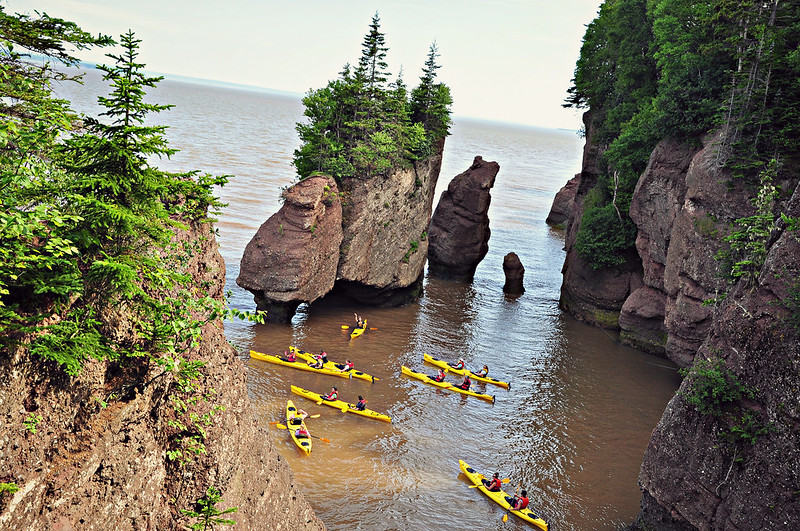
The phenomenon of tides is caused by the gravitational forces drawing water from oceans and seas in different directions causing it to rise and ebb. High and low tides fill and empty coastal areas with more prominent effects taking place at the time  of full and new moons, the equinox and supermoons.

Tidal ranges record the difference between high and low tide levels on the shore. The highest tides are recorded at the Bay of Fundy in Canada.


Bay of Fundy - Hopewell Rocks - New Brunswick
 

January 11, 2016

Stars in the Sea: Milky Seas

For centuries, mariners had reported incidents of the surface of the sea glowing an eerie blue at night. This phenomenon is known as the milky seas and is caused by luminous bacteria in sea water creating an effect known as "bioluminescence".


Milky Sea at Yacht Port of Zeebrugge, Belgium
© Hans Hillewaert / , via Wikimedia Commons
CC-BY-SA-4.0
Milky seas are more commonly reported in the Southern Indian Ocean and have been observed from high up in space.

Milky seas inspired some of the spectacular night effects in the Oscar award winning movie, Life of Pi.

These awe-inspiring phenomenon are a great tourist attraction throughout the world. Check out the Sea of Stars on Vaadhoo Atoll in Maldives in the Indian Ocean and the Bio Bays of  Peurto Rico for starters.

December 29, 2015

Water's Super States: Supercooling


Liquid water turns into solid ice at its freezing point of zero degrees C.
 
Under special conditions, water retains its liquid state even below freezing point. This state is known as supercooled water. Supercooling occurs when the temperature of a liquid drops below freezing point in the absence of seed nuclei required to create the crystal structure for a solid shape.
 
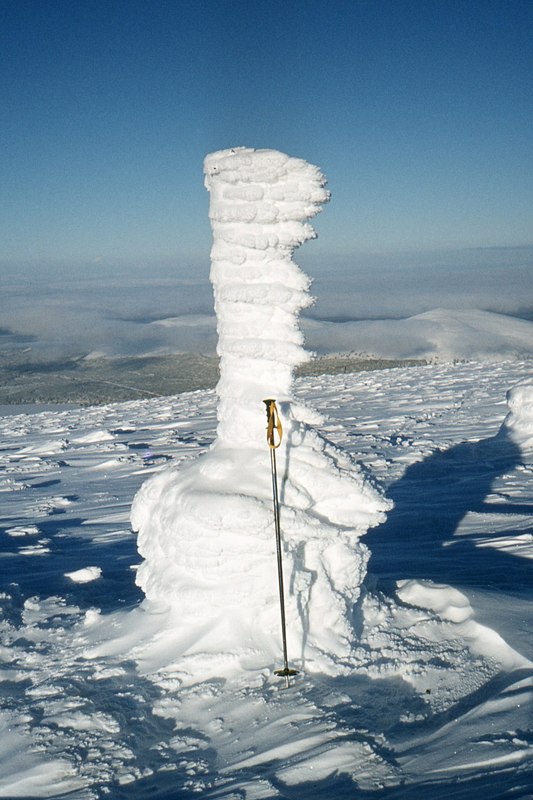
Supercooling is not a laboratory process, but occurs naturally in one of the most commonly observable phenomenon - clouds. The reaction of supercooled clouds with solid surfaces or heat from jet engines creates results in some stunning formations in nature.


Rimed post near Cairn Gorm summit in Scotland.  Compare with the picture below taken in summer.
Rime builds up in clouds when supercooled droplets (liquid water below freezing) carried by the wind impact on any obstacle and immediately freeze.
Photo By: Jim Barton [CC BY-SA 2.0 ], via Wikimedia Commons


Cairn Gorm summit in summer
Michael Graham [CC BY-SA 2.0], via Wikimedia Commons


December 28, 2015

Coral Reefs

Coral reefs are rocky formations created in marine areas by living organisms such as polyps and algae through the secretion and deposition of limestone over stony corals.

Coral reefs are built and grow over centuries into large and diverse coral reef ecosystems creating a complex habitat of aquatic plants, corals, fish and other marine species. They are sometimes referred to as "rainforests" of the sea.

Coral reefs can be found all over the world, although a majority of them exist in tropical zones.

Corals fringing the coast are a common sight but barrier reefs are largest and most impressive are of them. Barrier reefs are like large, continuous mountain ranges, separated from land by lagoons.

Australia's 2,000 km long Great Barrier Reef is visible from outer space
Image courtesy NASA/GSFC/LaRC/JPL, MISR Team
 

December 27, 2015

Water in Wild - 3

Blue Whale - NOAA Photo
Humpback whale - Megaptera novaeangliae - breaching. NOAA's Ark - Animals Collection
Image: NOAA

December 26, 2015

Deepest Spot on Earth: Challenger Deep in The Mariana Trench

Mount Everest in the Himalayas is the highest mountain peak on Earth, standing tall at 29,000 feet or approximately 5.5 miles from sea level. The Earth's oceans at some points are deeper than the highest mountain peaks. Deep under the oceans run mountain ranges, peaks, valleys and trenches as awesome in scale and variety as those above land.

The deepest known underwater point is Challenger Deep, in the 1500 mile long Mariana Trench which is one of the known deepest and longest underground trenches. Challenger Deep is 7 miles below sea level and can easily submerge Mount Everest.  At this depth, the water pressure is intense and temperatures at sub-zero, beyond the reach of sunlight.


Deep Challenger in Mariana Trench
Kmusser [GFDL , CC-BY-SA-3.0  or CC BY 2.5 ], via Wikimedia Commons
While marine life is found even at these unfathomable depths, it is very difficult for humans to descend there. Till date only two manned expeditions have been made to Challenger Deep.

Data + Design - May - Challenger Deep
From Visually
 
The first expedition was made in 1960 and second and most recent expedition, Deep Sea Challenge, was made by Hollywood film maker and undersea explorer James Cameron in collaboration with the National Geographic in 2012.
 

December 25, 2015

Seasons's Greetings Feature: Christmas Island

 
Imagine a beautiful island as a Christmas gift from Santa Claus! Christmas Island, an Australian territory in the Indian Ocean, is called so because it was first discovered by an English ship that sailed past it on Christmas day in the seventeenth century.
 
With numerous endemic species thriving in its forests and surrounding ocean, the island is often referred to as the Galapagos of the Indian Ocean. With a tropical climate, and December temperatures in the eighties (F), Christmas Island sounds like an ideal destination for a winter vacation as well.
 

December 21, 2015

Water and Life: Acquatic Ecosystems

As a source of life, water sustains an immense variety of life around and within it on Earth. 

Water based ecosystems are called aquatic ecosystems.

Saltwater and freshwater support entirely different ecosystems. There are multiple types of acquatic ecosystems on Earth.

Marine Ecosystems present in 71% of Earth's salwater i.e. oceans and sea.

Colorful underwater landscape of a coral reef example of marine ecosystem


Freshwater Ecosystems which have different variations depending on the type, flow and presence of water in the ground.

River Ecosystems in flowing rivers and water bodies.


River ecosystem salmon fish crossing in a river

Lake Ecosystems in lakes, ponds and other contained water bodies.
 

Lake ecosystem

Wetlands created by seasonal or permanent saturation of water in and around the ground.
Wetland ecosystem
 

December 19, 2015

The Color of the Sea

Water is a colourless or rather, a pale blue liquid.

Large water bodies like the oceans and seas get their distinct hues from reflecting the sky.

Algae, plankton, plants and sediments in water among other things, give different water bodies other distinguishing hues such as yellow, green and even red.

Four seas of the world are named after colours - the Black Sea, the Red Sea, the White Sea and the Yellow Sea. The name of the Black Sea refers to the North direction  than the actual colours of its water!

To check out all possible shades of the sea, head over to CITCLOPS or Citizens’ Observatory for Coast and Ocean Optical Monitoring who offer an interesting colour wheel to check out different shades of sea water on their website.

Green Yellow algae mix with blue rolling waters of an ocean


Fishing boats over a dark sea reflecting an overcast, sunset sky
Shades of the Sea
Images from Unsplash


December 18, 2015

How Much Water is there on Earth

The Earth is filled with water, in liquid form, which makes it unique in the solar system.

Water occupies 71% of Earth's surface, giving it its beautiful blue appearance when seen from space.
 Only 29 percent of the Earth's surface is land.  

Earth's Western and Eastern Hemispheres. NASA image.
Of  all water on, around and under earth is  only 1/100th or 1% is available as surface freshwater that is needed for sustaining human life.

The Earth is full of water but is it filled with water.  This popular illustration from USGS (U.S. Geological Survey) shows the stark contrast.

Credit: Howard Perlman, USGS/illustraion by Jack Cook, WHOI
There are three blue spheres in the image. The largest sphere shows the total amount of water, the smaller one, total freshwater and the smallest, freshwater in rivers and lake.

This is the complete USGS study on water on Earth and more.